
Most Indonesian import delays are not customs decisions. They are a permit nobody looked up.
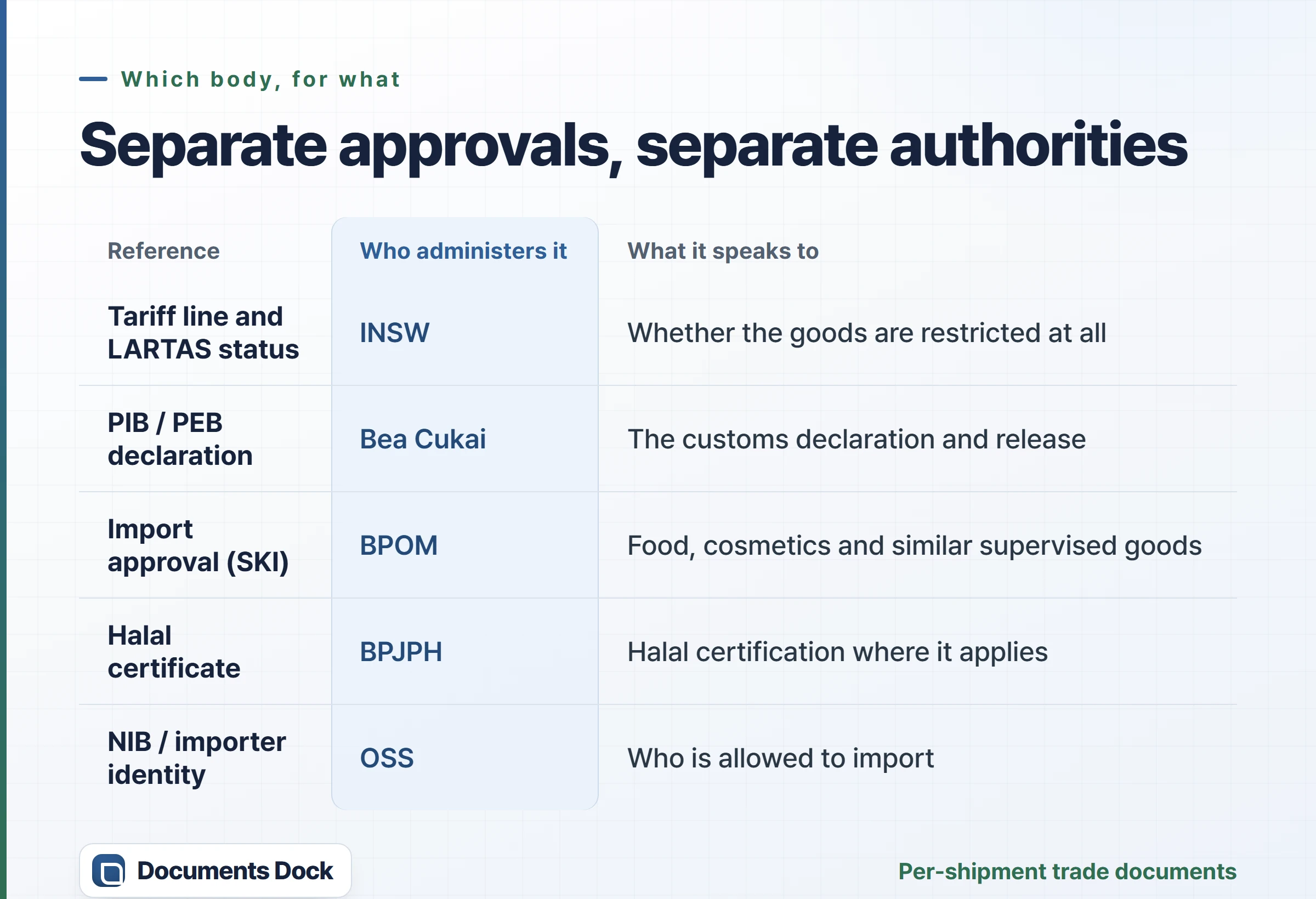
LARTAS is Indonesia's prohibited-and-restricted goods regime, and whether it applies to your shipment is determined per tariff line, not per product category. The commodity's 8-digit BTKI code is looked up in the Indonesia National Single Window, which shows the restriction and the agency approval attached to that line.
That distinction is the whole point. Importers reason by category — "it's just a food ingredient", "it's a spare part" — while the regime reasons by tariff line. Two products that feel like the same thing can sit on different lines with different approval requirements, and the line is what your broker declares. Checking the line early costs minutes; discovering it after arrival costs storage.
How do you know if your goods are subject to LARTAS?
You check the tariff line, not the product name. Indonesia declares on an 8-digit BTKI code aligned to the ASEAN Harmonised Tariff Nomenclature, and the Indonesia National Single Window publishes, per line, whether the goods are prohibited or restricted and which approval applies. Start from the WCO 6-digit subheading your supplier's documents suggest, then confirm the full 8-digit line before you rely on anything attached to it.
Confirming the line is genuinely a joint exercise. Your supplier's description and specification tell you what the goods physically are; the tariff schedule decides where they classify; and the final classification for the declaration is your PPJK broker's and Bea Cukai's call, not a guess from a product catalogue. Where classification is arguable, that is exactly the case to raise with the broker before shipment rather than after.
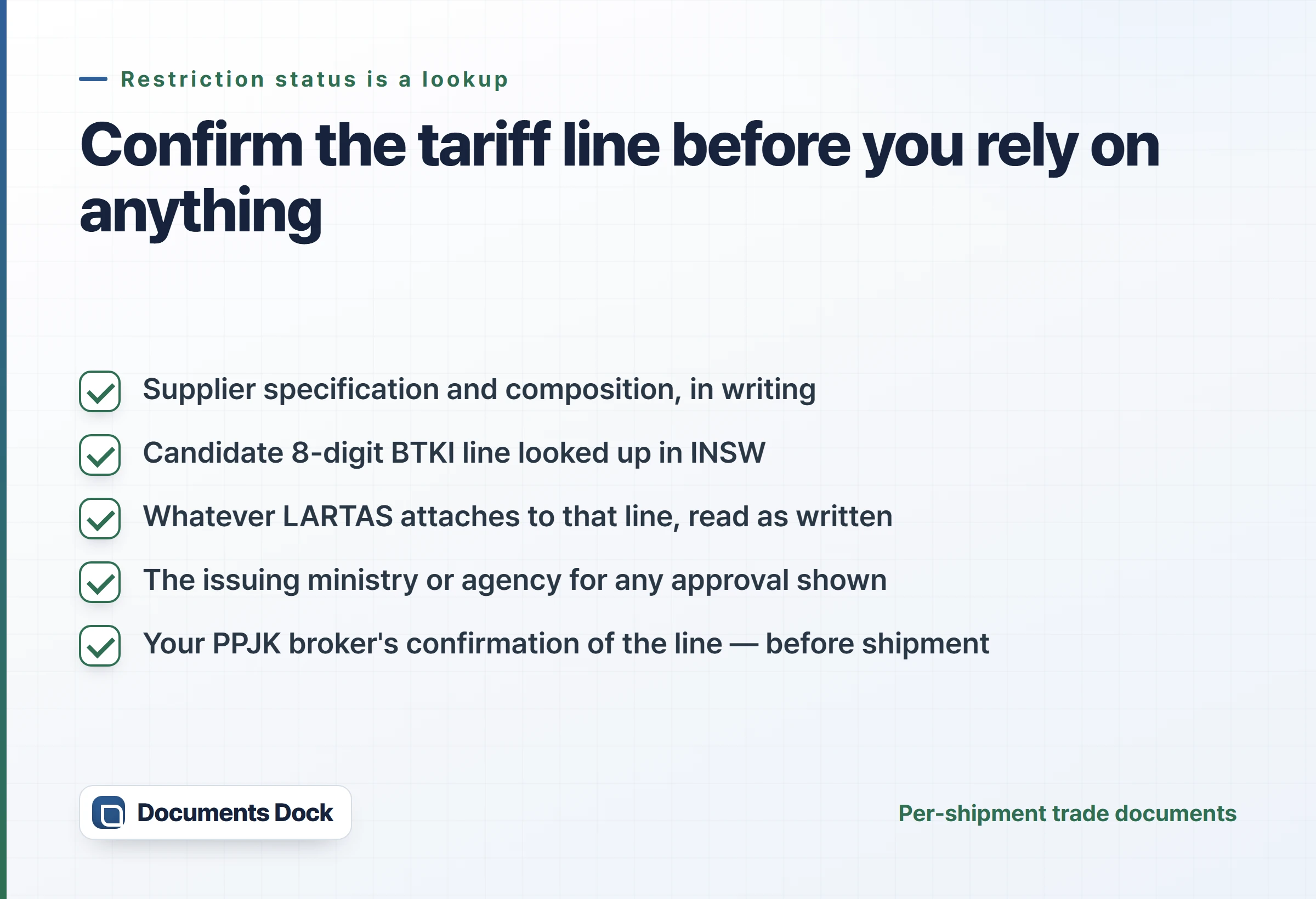
- Get the specification and composition from your supplier, in writing — this is what any classification argument rests on.
- Look up the candidate 8-digit BTKI line in INSW and read what is attached to it.
- Note the issuing ministry or agency for any approval shown against that line.
- Ask your PPJK broker to confirm the line before the goods ship, not after they arrive.
Who files the PIB in Indonesia?
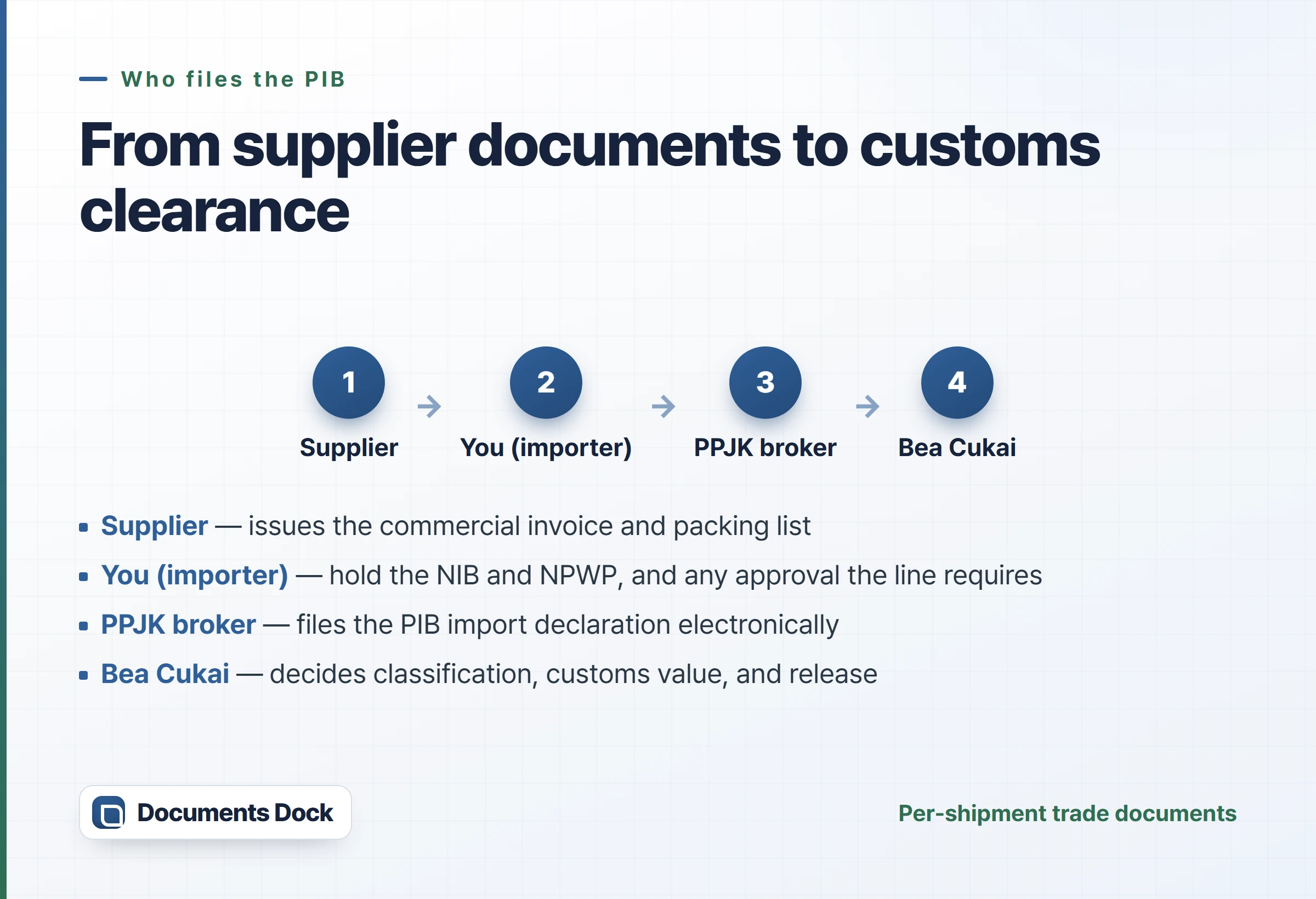
For most commercial imports, the goods are declared to the Directorate General of Customs and Excise (Bea Cukai) on a PIB — Pemberitahuan Impor Barang — submitted electronically, usually by a registered PPJK customs broker acting for the importer. The export equivalent is the PEB.
The broker files, but the declaration is assembled from your material: the commercial invoice and packing list from your supplier, the bill of lading or air waybill from the carrier or forwarder, your NIB and NPWP as the importer's identity, and any approval the tariff line requires. The broker can tell you that two of your documents disagree; they cannot decide which one is right.
The importer identity layer is worth getting straight once. Your Nomor Induk Berusaha (NIB), issued through the OSS system, carries the importer identification used for customs purposes, and your NPWP is the tax number that appears on the paperwork. Neither is something a broker can supply for you.
Category intuition is the failure mode
"It's just a sample" and "it's the same as last time" are the two assumptions that most often turn into a hold. The tariff line, not the description in your head, is what the declaration carries.
What does a BPOM import approval cover?
Separately from customs, some goods are supervised by BPOM, Indonesia's food and drug authority — food, beverages, cosmetics, supplements and similar categories — and their import can require an approval, the Surat Keterangan Impor (SKI). What that approval gates is release, so the practical deadline is earlier than it looks: an application still in progress when the goods land leaves the cargo waiting rather than cleared. Where halal certification applies, the certificate is administered through BPJPH. Certain products also fall under mandatory SNI, the Indonesian National Standard.
Whether any of these applies to your specific goods is not something to infer from a general guide: it depends on the composition, the intended use, and the tariff line. The practical move is to identify which of them is even in play early, then confirm scope with the agency or your broker. What you can do unilaterally is keep the references and their validity dates where the shipment can see them:
- The approval or permit reference for any restriction attached to the tariff line, and the ministry that issued it.
- The BPOM product registration and SKI reference where the goods are BPOM-supervised.
- The halal certificate reference where halal certification applies to the goods.
- The SNI certificate where the product falls under a mandatory standard.
- The expiry or validity date of each — an approval that lapsed between order and arrival is still a stop.
Approvals gate release, not arrival
An approval that is still in progress when the goods land does not stop the clock — the cargo waits, and storage accrues while it does. Confirm what your goods need, and whether it is still valid, with the issuing agency or your PPJK broker before shipment.
The checklist before your PPJK files
None of this is exotic; it is the ordinary order of operations, done before the container is on the water rather than after. The same suppliers and the same goods come back shipment after shipment, so the lookup only has to be done properly once per line:
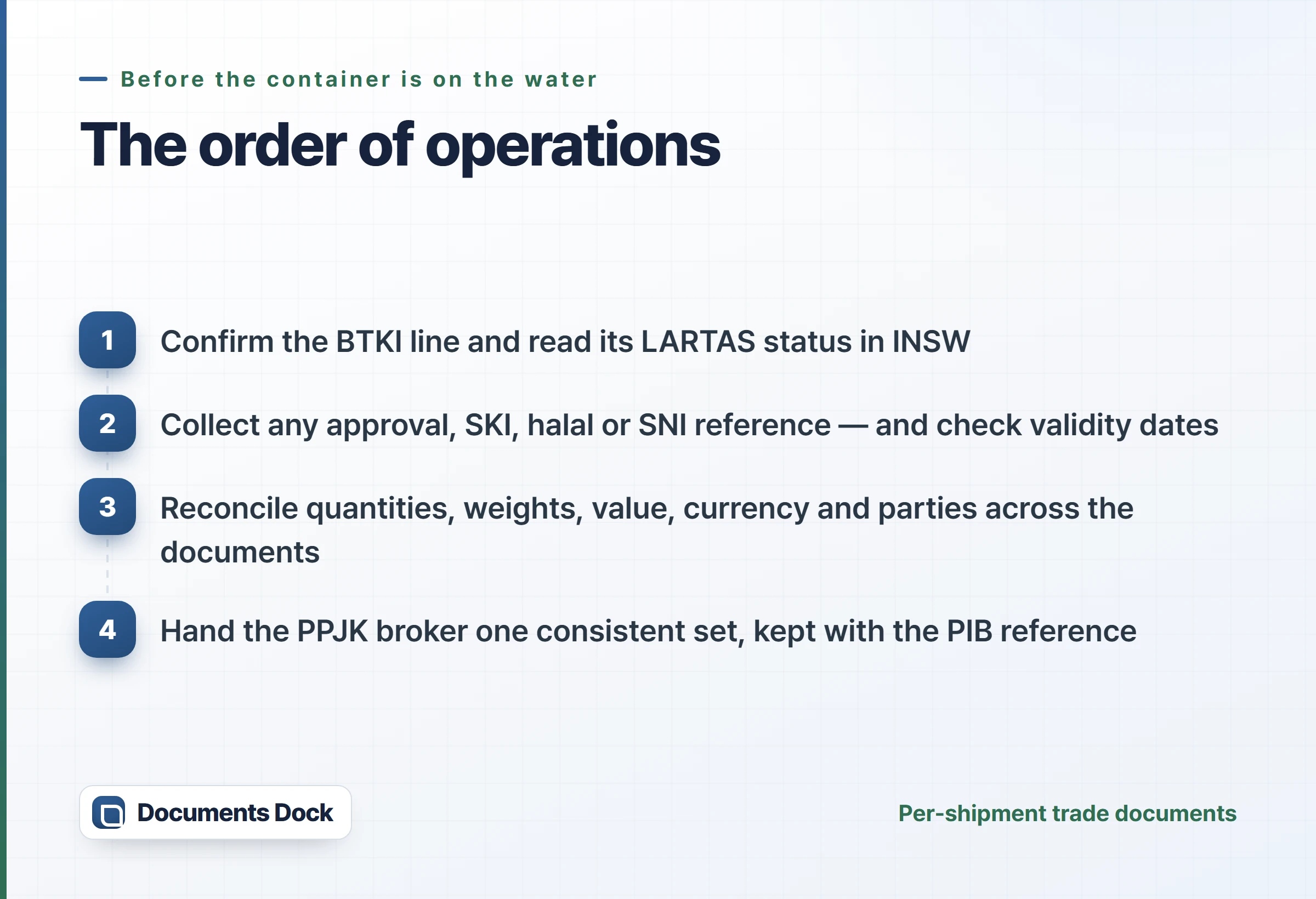
- Confirm the candidate BTKI line and read what LARTAS attaches to it in INSW.
- Collect any required approval, SKI, halal or SNI reference, and check the validity dates.
- Reconcile quantities, weights, value, currency, and party names across invoice, packing list, and transport document — a disagreement here is what turns into a query at the border, the same way it does when a shipment is held.
- Hand your PPJK broker one consistent set, then keep it with the PIB reference per shipment so a later question has a single source.
Before your broker files
Before you submit, Documents Dock flags where quantities, amounts, and weights disagree across your documents — and keeps the approvals and the PIB reference with the shipment they belong to. See it at documentsdock.com.
This is general information, not a compliance ruling. Whether a restriction, approval, registration or standard applies to your goods depends on their composition, use, and tariff classification — confirm with a registered PPJK customs broker, Bea Cukai, or the relevant agency.
Related: India export documents and the eBRC.
- Indonesia National Single Window (INSW) — insw.go.id (tariff line, LARTAS status, permit information)
- Directorate General of Customs and Excise (Bea Cukai) — beacukai.go.id (PIB / PEB declarations)
- BPOM, Indonesia — pom.go.id (import approval / SKI for supervised goods)
- BPJPH, Halal Product Assurance Agency — halal.go.id (halal certification)
- Online Single Submission (OSS) — oss.go.id (NIB / importer identification)