
You sell twelve pallets CFR Hamburg and pay the ocean freight yourself. Mid-ocean the container is water-damaged. The freight is still your bill, and the loss is the buyer's. Nothing has gone wrong — that is the rule working exactly as written.
Under Incoterms 2020, who pays for shipping depends on the agreed rule: the seller pays the main carriage under CFR, CIF, CPT, CIP, DAP, DPU, and DDP; the buyer pays it under EXW, FCA, FAS, and FOB. Only CIF and CIP oblige the seller to insure the goods for the buyer's benefit.
The International Chamber of Commerce publishes eleven three-letter rules. Each answers three separate questions: who arranges carriage, who pays for it, and where risk moves from seller to buyer. Reading those three as a single line is how a shipment gets mispriced or a claim gets misplaced.
What follows is the money and the risk — who pays, who bears the loss, who insures. The documents each rule then obliges you to produce are covered from the document side in the full export document set, in order.
Why is who pays not the same as who bears the risk?
Cost transfer and risk transfer are separate points in every Incoterms rule, and they meet only in some of them. Cost transfer is where the buyer starts paying for the journey; risk transfer is where the buyer starts losing if the goods are damaged or lost in transit.
In the E, F, and D rules the two points coincide — EXW, FCA, FAS, and FOB hand over near origin; DAP, DPU, and DDP carry both to the named destination.
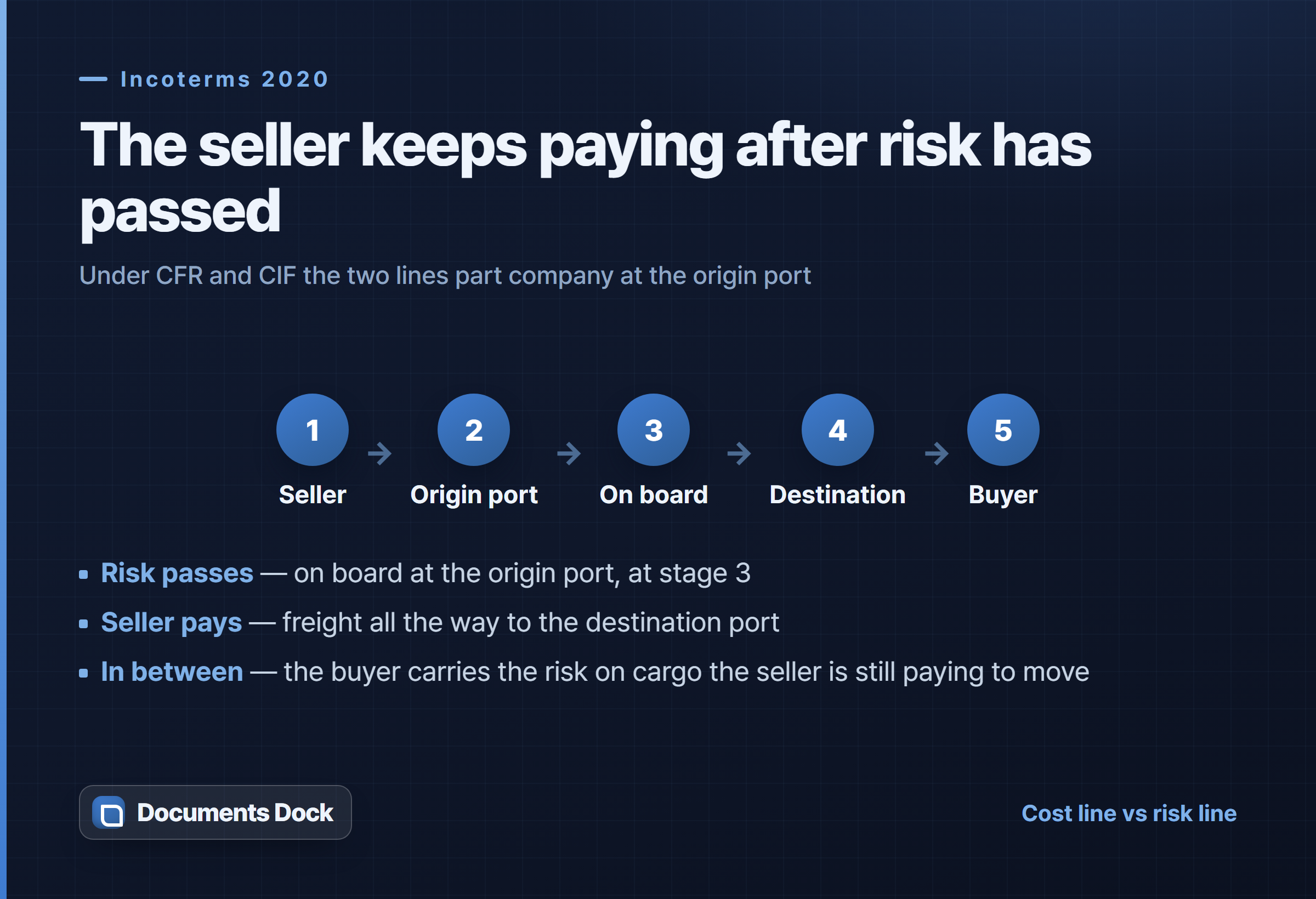
The four C rules — CFR, CIF, CPT, and CIP — are the exception. The seller contracts and pays for carriage to the named destination, but delivery still happens at origin. The seller is buying transport for goods that are already at the buyer's risk.
Where the C rules split
Under CFR and CIF the seller pays freight to the destination port while risk passes at the origin port, once the goods are on board. Under CPT and CIP the split is the same but risk passes earlier still — on handover to the first carrier.
Who pays for shipping under each Incoterms 2020 rule?
Two things hold across all eleven: export clearance is the seller's job under every rule except EXW; import clearance, with its duty and taxes, is the buyer's under every rule except DDP.
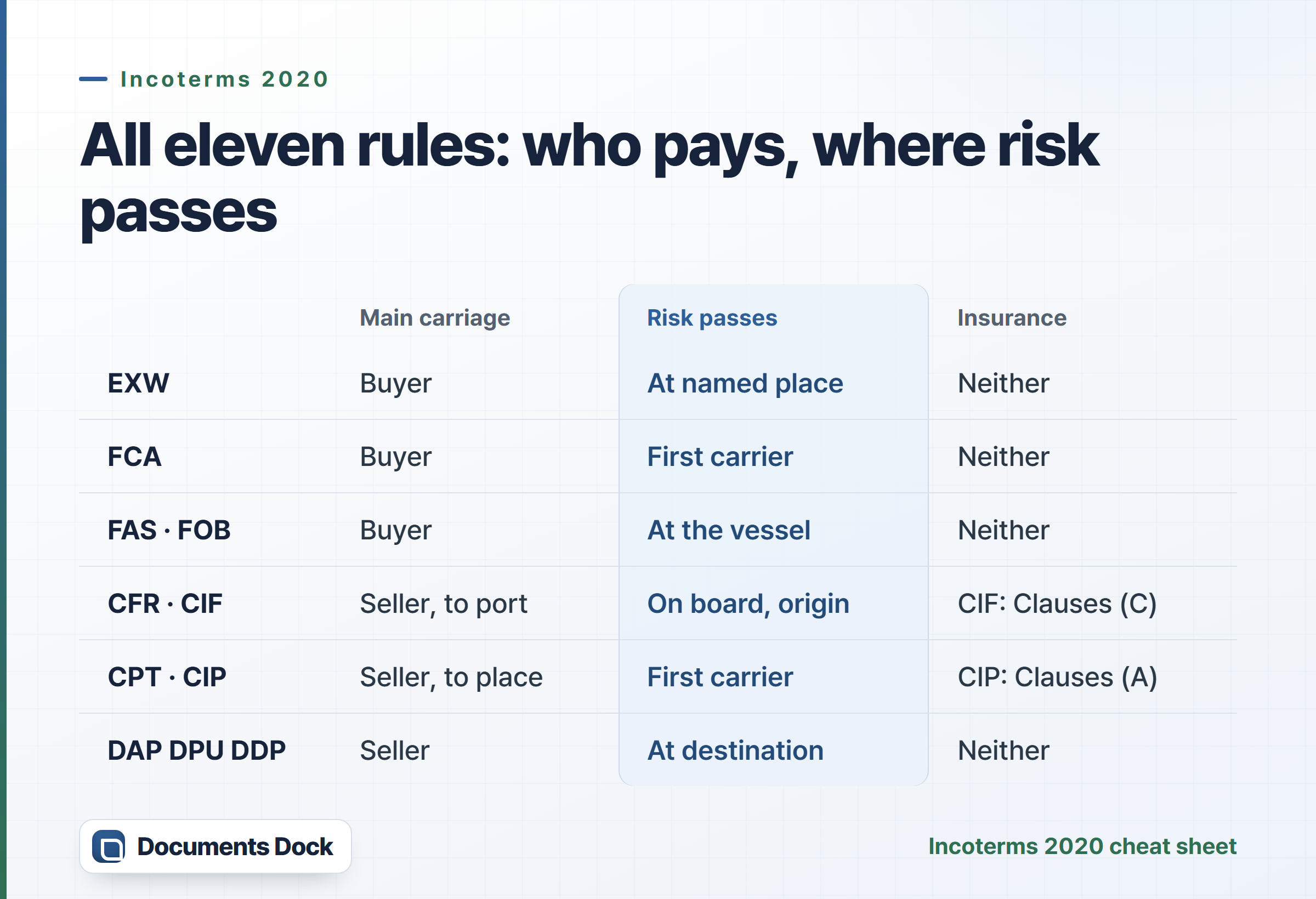
- **EXW (Ex Works, named place)** — Main carriage: buyer. Risk passes: when the goods are placed at the buyer's disposal at the named place, not loaded. Insurance: neither party obliged.
- **FCA (Free Carrier, named place)** — Main carriage: buyer. Risk passes: on delivery to the buyer's nominated carrier — loaded onto the collecting vehicle at the seller's premises, or on the seller's arriving vehicle ready for unloading anywhere else. Insurance: neither party obliged.
- **FAS (Free Alongside Ship, named port of shipment)** — Main carriage: buyer. Risk passes: when the goods are alongside the nominated vessel. Insurance: neither party obliged.
- **FOB (Free On Board, named port of shipment)** — Main carriage: buyer. Risk passes: when the goods are on board the vessel. Insurance: neither party obliged.
- **CFR (Cost and Freight, named port of destination)** — Main carriage: seller, to the destination port. Risk passes: on board at the origin port. Insurance: neither party obliged.
- **CIF (Cost, Insurance and Freight, named port of destination)** — Main carriage: seller, to the destination port. Risk passes: on board at the origin port. Insurance: seller must cover the buyer, minimum Institute Cargo Clauses (C).
- **CPT (Carriage Paid To, named place of destination)** — Main carriage: seller, to the named destination. Risk passes: on handover to the first carrier. Insurance: neither party obliged.
- **CIP (Carriage and Insurance Paid To, named place of destination)** — Main carriage: seller, to the named destination. Risk passes: on handover to the first carrier. Insurance: seller must cover the buyer, minimum Institute Cargo Clauses (A).
- **DAP (Delivered at Place, named place of destination)** — Main carriage: seller. Risk passes: at the destination, on the arriving vehicle ready for unloading; the buyer unloads. Insurance: neither party obliged.
- **DPU (Delivered at Place Unloaded, named place of destination)** — Main carriage: seller. Risk passes: at the destination, once the seller has unloaded — the only rule that obliges the seller to unload, so check you can. Insurance: neither party obliged.
- **DDP (Delivered Duty Paid, named place of destination)** — Main carriage: seller, plus import clearance, duty, and any import taxes. Risk passes: at the destination, ready for unloading. Insurance: neither party obliged.
Name the place, and the edition
FOB alone is incomplete; FOB Port of Busan is a term, because the named place fixes the delivery point. Name the edition too — Incoterms 2020 did not delete Incoterms 2010, and a bare CIP leaves the insurance level arguable: Clauses (C) under the 2010 edition, Clauses (A) under 2020. DAT became DPU in 2020, and DDU, DES, DEQ, and DAF have not been current rules for years.
Which rules oblige the seller to insure, and at what level?
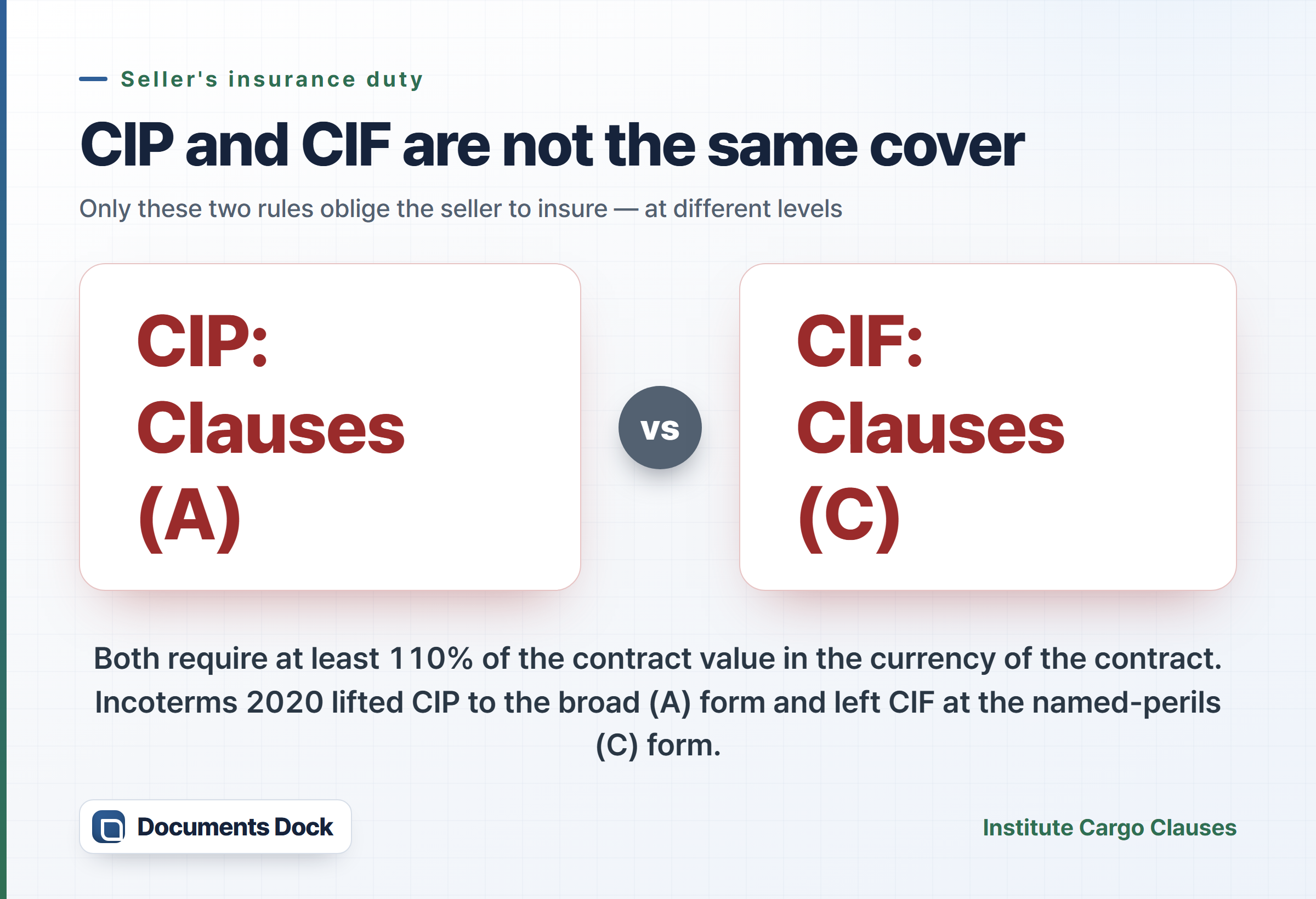
Only two of the eleven rules oblige the seller to buy cargo insurance for the buyer's benefit: CIF and CIP. CIP requires cover at Institute Cargo Clauses (A); CIF requires only Institute Cargo Clauses (C). Both require a minimum of 110% of the contract value, in the currency of the contract.
The Institute Cargo Clauses are the standard market wordings for cargo cover: (A) is the broad all-risks form, subject to a list of exclusions; (C) responds to a shorter, named set of major casualties. A loss that (A) would answer can fall entirely outside (C) — the difference between a claim paid and a claim declined.
This was the headline change in Incoterms 2020. Under the 2010 edition both rules sat at Clauses (C); the 2020 revision lifted CIP to (A) and left CIF where it was.
The minimum is a floor the rule sets, not a judgement that the cover suits your cargo. If your goods need a different level, agree it and write it into the contract.
CIP and CIF are not the same insurance
A CIP shipment insured at Institute Cargo Clauses (C) sits below the rule's default minimum unless the contract says otherwise. Move a lane from CIF to CIP, keep the same policy, and the cover has quietly fallen short.
Which Incoterms rules only work for sea freight?
Four rules are for sea and inland waterway transport only: FAS, FOB, CFR, and CIF. The other seven — EXW, FCA, CPT, CIP, DAP, DPU, and DDP — work with any mode, including road, rail, air, and multimodal movements. The reason is mechanical: FAS delivers alongside a vessel and FOB, CFR, and CIF deliver on board one, and those points only exist if there is a ship.
This bites hardest with containers. Risk under FOB, CFR, and CIF passes when the goods are on board — but a container is usually handed to the carrier at a terminal days before loading, leaving a window in which the seller bears risk on goods it has already surrendered and can no longer protect. ICC guidance points to FCA, CPT, and CIP for containerised cargo, because those rules pass risk at the handover that actually happens.
The usual objection is that a letter of credit wants an on-board bill of lading, which FOB produces naturally. Incoterms 2020 answered that: under FCA the parties can agree that the buyer instructs its carrier to issue an on-board bill of lading once the goods are loaded, which the seller then obtains and tenders to the buyer — through the bank, where a letter of credit is in play.

What is the difference between EXW and DDP?
EXW and DDP are the two ends of the scale. Under EXW the seller does the least a rule allows — it makes the goods available at its own premises and stops — so the buyer carries the maximum obligation. Under DDP the seller does the most: delivery to the named destination, cleared for import, with duty and any import taxes paid.
EXW has an awkwardness that is easy to miss when the quote looks cheap. Export clearance sits with the buyer, and in many countries a foreign buyer cannot readily act as exporter of record or file an export declaration in its own name. FCA at the seller's premises usually says what people actually mean by EXW.
DDP has the mirror-image problem: the seller takes on import clearance, duty, and any import taxes such as VAT or GST, in a country where it may be neither registered nor able to recover them. An import tax the seller cannot recover comes straight out of the margin. DAP or DPU still delivers to the door while leaving import clearance with the buyer.

Cheap at the quote, expensive at the filing
EXW leaves export clearance with a buyer who often cannot perform it; DDP leaves import duty and taxes with a seller who often cannot recover them. Both get chosen for their apparent simplicity, and both are simple only until someone has to file something.
Put the rule where the documents can see it
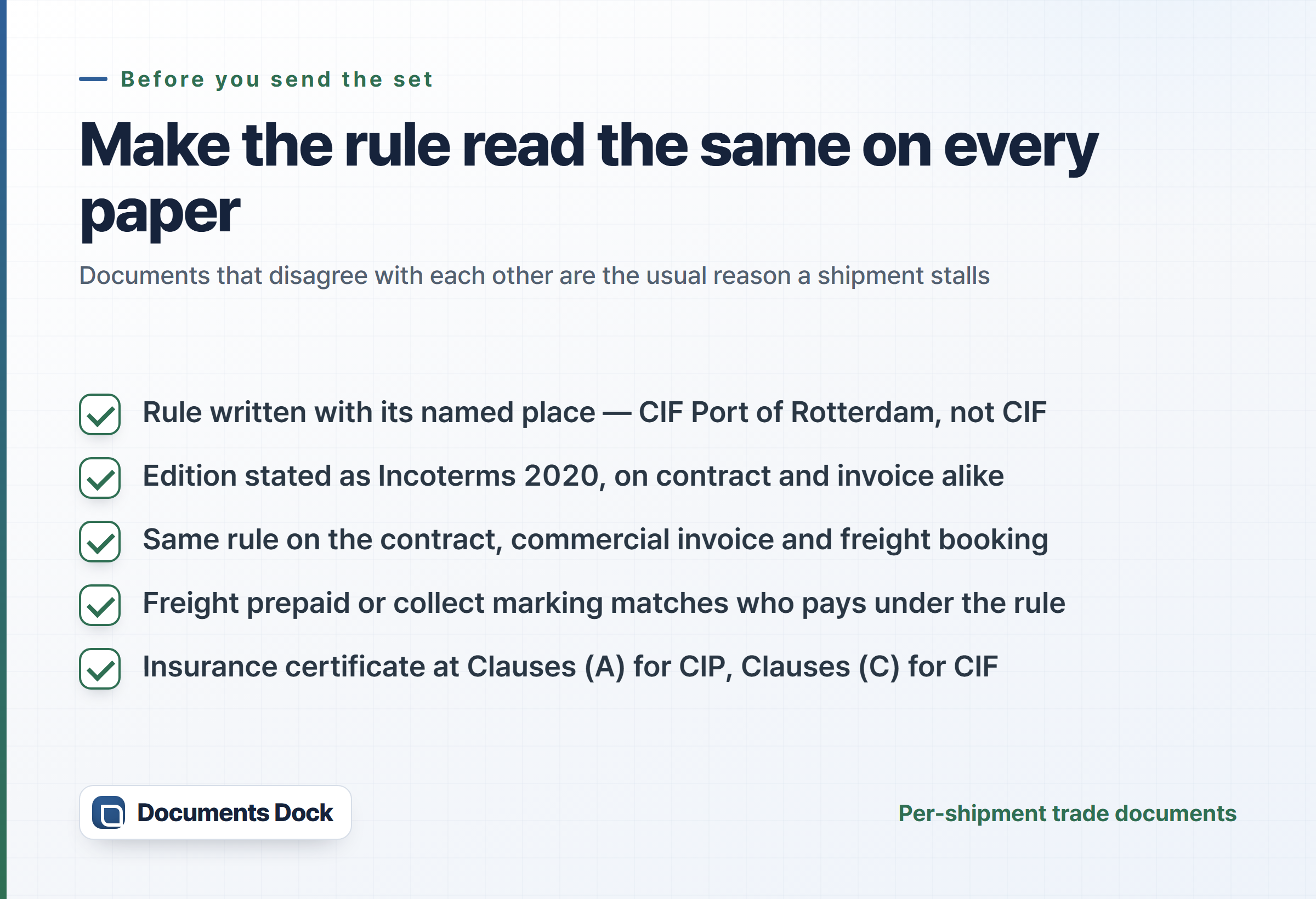
Choosing the rule is half the job. The other half is making it read the same everywhere it is quoted — contract, commercial invoice, freight booking, insurance certificate. A sale invoiced CIP with a certificate of insurance issued at Institute Cargo Clauses (C) contradicts the rule it quotes: the paper promises one level of cover, the term another. Papers that disagree with each other are the usual reason a shipment stalls at customs.
On the invoice, write the rule with its named place — CIF Port of Rotterdam, not CIF. The field-by-field treatment is in how to write a commercial invoice, and the weights and quantities the freight was priced against have to reconcile with it, which how to write a packing list covers from the other side.
Documents Dock keeps the commercial invoice, packing list, transport document, and any insurance certificate together per shipment — so the term you agreed reads the same on every paper that quotes it. Keep the set in one place at documentsdock.com.
Sources and scope
This is general information, not legal, insurance, or contractual advice. Which rule suits a sale — and what cover, clearance, or delivery point it commits you to — depends on your goods, your countries, your transport mode, and your contract. Confirm the commercial consequences with a licensed customs broker, your insurer, or a legal adviser before you commit to a term.
Incoterms® is a registered trademark of the International Chamber of Commerce. The obligations above are paraphrased in plain language for orientation; the authoritative wording of each rule is in the ICC's own Incoterms 2020 publication.
- International Chamber of Commerce (ICC) — Incoterms® 2020 rules (iccwbo.org/business-solutions/incoterms-rules/incoterms-2020)
- ICC Academy — Incoterms 2020 training and explainers (icc.academy)
- U.S. International Trade Administration, trade.gov — Know Your Incoterms (trade.gov)
- U.S. International Trade Administration, trade.gov — Common Export Documents (trade.gov/common-export-documents)